
Tactile Directional Strip vs Warning Studs: Understanding Their Applications
- eliteinformationte
- Mar 27
- 3 min read
The development of secure and accessible public places is no longer a choice. It is a responsibility. The tactile guides help to direct the blind or people with visual impairments towards the sidewalks, railway stations, airports, shopping malls, and commercial premises. In creating an upgrade in accessibility, you have likely come across two popular solutions, i.e., tactile directional strips and warning studs.
Knowing the difference between the tactile directional strip and warning studs assists you in selecting the appropriate product for your project. At MetalX Engineering Inc., we collaborate with architects, contractors, and facility managers to make sure that all installations are safe and compliant and remain affordable and durable.
Understanding Are Tactile Directional Strips
Tactile directional strips are long, linear bars installed on walking surfaces. Their main role is to guide individuals on the right and secure path. The raised bars provide a distinct physical indication of direction when one uses a cane or when one walks over them.
Applications of Directional Strips
Directional strips are commonly installed in:
● Railway stations
● Bus terminals
● Airports
● Large commercial complexes
● government, hospital buildings
● Outdoor pathways and plazas
Key Benefits of Tactile Directional Strips
1. Provide continuous navigation guidance
2. Help users follow a straight route safely
3. Minimize the confusion within the large, open areas
4. Enhance adherence to standards of accessibility.
They are best in cases where the target is to take one person to another without any form of hurdles.
Understanding Warning Studs
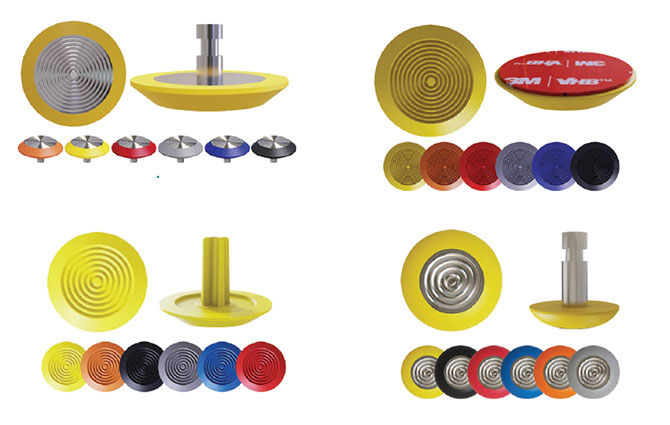
Warning studs, also known as tactile attention indicators, consist of small raised domes installed in a grid pattern. Unlike directional strips, they do not directly guide people; rather, they give pedestrians a warning of possible dangers.
When someone steps on warning studs, the change in surface texture immediately signals caution.
Common Applications of Warning Studs
Warning studs are typically placed at
● Platform edges
● Staircases
● Escalator entries
● Pedestrian crossings
● Ramps
Why Warning Studs Matter
● Alert users before hazards
● Minimize the possibility of falls and slips.
● Increase safety at height transitions
● Clearly mark dangerous zones
At MetalX Engineering Inc., we often recommend combining both systems to create a complete tactile guidance network that ensures maximum safety.

Tactile Directional Strips vs. Warning Studs: The Core Difference
Understanding the core difference between tactile directional strips vs. warning studs comes down to function.
Directional Strips
● Purpose: Guide movement
● Shape: Long raised bars
● Placement: Along walking paths
● Message: Follow this route
Warning Studs
● Purpose: Alert to danger
● Shape: Round raised domes
● Placement: Near hazards or edges
● Message: Stop and be cautious
The two products are necessities, though they have different purposes. Replacement of one of them with the other can reduce effectiveness and compromise safety.
Selecting The Correct Alternative For Your Project
Coming up between directional strips or warning studs is dependent on the site of the project and accessibility. Find out:
● Do users need guidance across a wide area?
● Is it a dangerous side?
● Do you meet the local requirements of accessibility?
The combination of both of these solutions is a common feature of a well-constructed tactile system. The type of materials and effective installation are also vital. Here, stainless steel can bear heavy traffic, whereas polyurethane can be used indoors.
MetalX Engineering Inc. guides clients from product selection to final installation, which will guarantee the durability and performance of the product and ensure compliance with regulations.
Conclusion
While distinguishing the difference between tactile directional strips and warning studs, remember one easy rule: strips are for guidance while studs are for warning. Both of them are essential elements of an accessible environment. Installation of appropriate tactile indicators enhances navigation and saves lives.
When considering accessibility upgrades or new construction, select tactile solutions of high quality, which are durable and compliant. Join hands with MetalX Engineering Inc. and start a conversation with us about your needs and create safer and more inclusive spaces with ease.
FAQs
1. Would it be possible to use directional strips and warning studs concurrently?
Yes, they are sometimes used together to design an efficient tactile guidance system.
2. Is the use of tactile indicators compulsory for public spaces?
In most locations, accessibility laws require tactile signs in certain social locales.
3. Which material can we use for an outdoor tactile indicator?
It is stainless steel as it is durable and commonly preferred in outdoor and high-traffic areas.
4. How long do the directional strips of tactile last?
With good installation and quality materials, they can last for many years.
Comments